Secondary Sections
Curriculum Overview
The new system of education according to the Egyptian Ministry of Education depends mainly on understanding and applying academic concepts rather than memorizing. This gets reflected along the educational process; the teaching methodologies focus on higher levels of student awareness and allow students to direct their efforts to apply and analyze the academic concepts in various curricula.
This is also evident in the ongoing assessments that measure the students’ actual understanding rather than their memorization capacity of the learned concepts.
Moreover, to reach the best educational experience, MLS is keen to adopt interactive and rich learning experiences along with the skills and knowledge needed to embark on a bright future in the 21st culture with its evolving challenges through co -circular activities and extracurricular activities. Remarkable participation in international and local competitions and scoring high ranks adds flavour to the learning process. Career counseling is part and parcel of our educational journey where opportunities for internships are offered to enable students to further explore their future choices with a more realistic vision.
The Secondary Stage is a three-phase stage:
In Grade 10, students study a wide range of subjects including Arabic, two foreign languages, Math, Geography, History, Philosophy, Physics, Chemistry, Biology, Religion, Civics, and ICT.
In Grades 11 and 12, students study three compulsory subjects, namely Arabic, and two foreign languages, while the rest of their subjects depend on the individual’s choices, with all students required to choose between Math or Science or Arts Sections.
A student who prefers the Arts Section will study History, Geography, Philosophy, and psychology.
Students who choose the Science Section will study Physics, Chemistry, Biology, and Geology.
Students who join the Math Section cover Physics, Chemistry, Statics and Dynamics, Algebra, Solid Geometry, as well as Differentiation and Integration.
Religion, Civics, Economics, and statistics are also compulsory subjects, but these are not included in a student’s GPA.
Related Pages
-
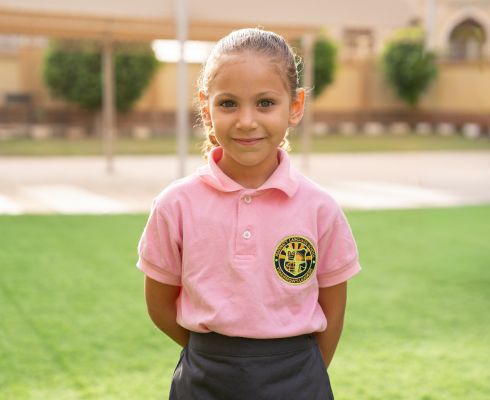
Kindergarten
Our Early Years programme is designed to plunge into areas of exploration, cooperation, communication, and physical movement.
-
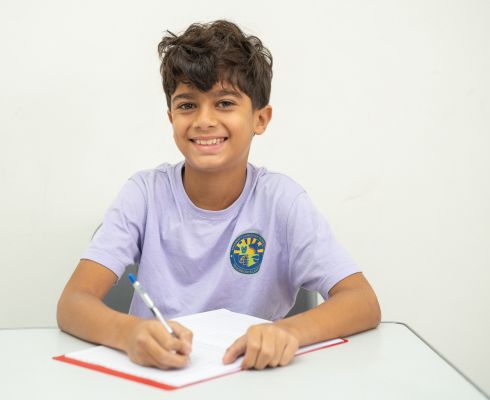
Primary School
Our Primary school is a six-year phase, during which our basic scope is to build on the foundations laid during the early years of education.
-
Preparatory Sections
Preparatory Section This is a three-phase stage that requires a high level of understanding and awareness on the part of the school, parents, and students.


